
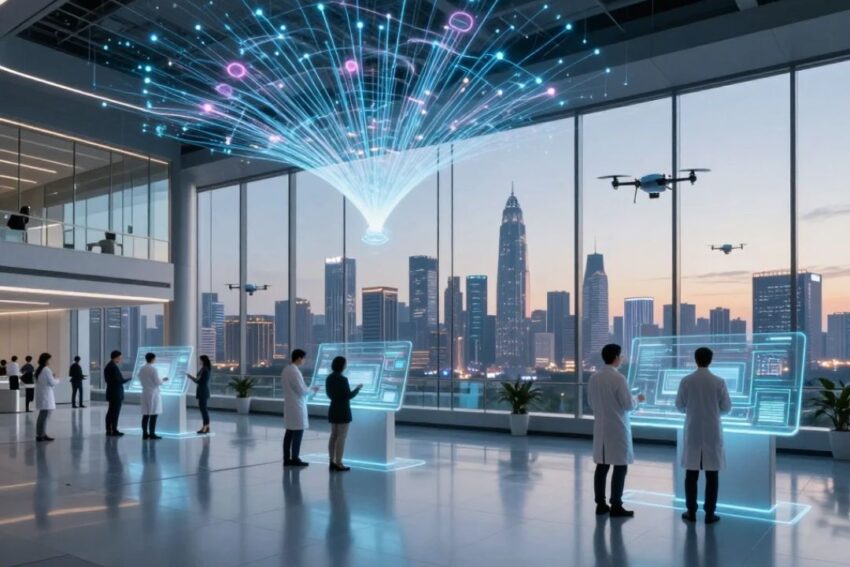
Introduction
Technology is changing the world faster than ever. From artificial intelligence and robotics to quantum computing, clean energy, biotechnology, and advanced connectivity, new innovations are creating opportunities that were difficult to imagine only a few years ago.
In 2026, the future of technology is becoming increasingly connected, intelligent, automated, and sustainable. Businesses are using emerging technologies to improve productivity, reduce costs, develop new products, and create better customer experiences.
At the same time, consumers are gaining access to smarter devices, AI-powered applications, connected vehicles, immersive digital experiences, and advanced healthcare solutions.
This article explores the revolutionary technology trends of 2026, their applications, benefits, challenges, and future opportunities.
What Is the Future of Technology?
The future of technology refers to the innovations and developments expected to influence how people and organizations live and work.
Important areas include:
- Artificial intelligence
- Robotics
- Quantum computing
- Biotechnology
- Clean energy
- Advanced semiconductors
- Extended reality
- Autonomous systems
- Cloud computing
- Edge computing
- Advanced networking
These technologies are increasingly connected. AI can power robots, cloud platforms can support AI, and edge computing can enable autonomous machines to make decisions in real time.
1. Artificial Intelligence
Artificial intelligence is likely to remain one of the most influential technologies of the future.
AI allows computers to analyze information, identify patterns, generate content, and perform increasingly sophisticated tasks.
Major Applications
AI is being used in:
- Healthcare
- Finance
- Education
- Marketing
- Cybersecurity
- Manufacturing
- Software development
- Customer service
Generative AI is also changing how people create text, images, videos, audio, and software.
Future Opportunity
AI could become a standard layer within many digital products, rather than a separate technology.
2. AI Agents
AI agents are an important development beyond traditional chatbots.
Instead of only answering questions, AI agents can potentially complete multi-step workflows.
For example, an AI agent could:
- Understand a task.
- Research information.
- Analyze results.
- Use software tools.
- Complete actions.
- Produce a final report.
Business Applications
AI agents could transform:
- Customer support
- Research
- Business administration
- Software development
- Data analysis
- Personal productivity
As these systems improve, organizations may automate increasingly complex workflows.
3. Robotics and Humanoid Machines
Robotics is entering a new phase as AI improves machine perception and decision-making.
Modern robots can combine:
- Cameras
- Sensors
- AI
- Machine learning
- Advanced motors
- Computer vision
Applications
Robots can support:
- Manufacturing
- Warehousing
- Healthcare
- Agriculture
- Logistics
- Exploration
Humanoid robots are particularly interesting because they can potentially operate in environments designed for humans.
4. Autonomous Transportation
Autonomous technology is changing the future of transportation.
Self-driving systems combine:
- AI
- Cameras
- Radar
- Sensors
- Mapping
- High-performance computing
Potential Applications
Autonomous systems could eventually become more common in:
- Cars
- Trucks
- Delivery vehicles
- Drones
- Industrial transport
Autonomous transportation could improve efficiency, but safety, regulation, and reliability remain essential concerns.
5. Quantum Computing
Quantum computing is one of the most advanced areas of computer science.
Quantum computers use quantum mechanical principles to process certain types of information differently from traditional computers.
Potential Applications
Quantum computing could eventually help with:
- Drug discovery
- Materials research
- Complex optimization
- Scientific simulation
- Cryptography
- Financial modeling
Although the technology remains under development, it could have a major impact on specialized computing problems.
6. Biotechnology
Biotechnology is combining biology, engineering, and advanced computing.
Important areas include:
- Gene editing
- Synthetic biology
- Personalized medicine
- Computational biology
- Agricultural biotechnology
AI and Biotechnology
AI can help researchers analyze biological information and identify patterns in large datasets.
This combination could accelerate scientific discovery and the development of new treatments.
7. Personalized Healthcare
Healthcare is becoming increasingly personalized through AI, genomics, connected devices, and data analytics.
Future healthcare technologies may help doctors and researchers understand individual patients more precisely.
Technologies Supporting Personalized Healthcare
- Genetic analysis
- AI-assisted diagnostics
- Wearable devices
- Remote monitoring
- Digital health platforms
These technologies could improve early detection and personalized treatment while requiring strong privacy protections.
8. Extended Reality
Extended reality includes:
- Virtual reality
- Augmented reality
- Mixed reality
These technologies create immersive digital environments or place digital information within the physical world.
Future Applications
XR could transform:
- Education
- Gaming
- Training
- Healthcare
- Engineering
- Retail
- Remote collaboration
As hardware becomes smaller and more powerful, immersive technology could become more mainstream.
9. Spatial Computing
Spatial computing allows digital content to interact with physical environments.
Users can potentially manipulate virtual objects using natural movements and spatial interfaces.
Potential Applications
Spatial computing could support:
- Product design
- Architecture
- Education
- Healthcare
- Engineering
- Entertainment
It represents a shift from traditional screen-based interaction toward more immersive computing.
10. Edge Computing
Edge computing processes information closer to where it is generated.
For example, a connected industrial machine can analyze sensor information locally rather than sending every piece of data to a distant cloud.
Benefits
Edge computing can provide:
- Lower latency
- Faster responses
- Reduced network traffic
- Greater reliability for some applications
Future Applications
Edge computing can support:
- Robotics
- Smart factories
- Autonomous vehicles
- Healthcare devices
- IoT
- Smart cities
11. Advanced Connectivity
Connectivity is becoming more important as billions of devices become connected.
5G and future networking technologies can provide:
- Faster speeds
- Lower latency
- Greater capacity
- More reliable connections
Applications
Advanced connectivity can support:
- Autonomous systems
- Smart cities
- Connected vehicles
- Industrial automation
- Cloud gaming
- Immersive experiences
12. Internet of Things
The Internet of Things connects physical devices to digital systems.
Examples include:
- Smart appliances
- Wearable devices
- Connected vehicles
- Industrial sensors
- Smart-home equipment
Future of IoT
The next generation of IoT will increasingly combine:
Sensors + Edge Computing + AI + Cloud
This can allow devices to collect information, analyze it, and respond automatically.
13. Advanced Semiconductors
Semiconductors are essential for modern computing.
The rise of AI has increased demand for specialized processors and accelerators.
Future semiconductor innovation will focus on:
- AI chips
- Energy efficiency
- High-performance computing
- Specialized processors
- Advanced manufacturing
Why Semiconductors Matter
More powerful and efficient chips can enable better AI systems, smartphones, vehicles, robots, and data centers.
14. Clean Energy Innovation
Technology is playing an important role in the transition toward cleaner energy.
Important innovations include:
- Solar power
- Wind energy
- Battery storage
- Smart grids
- Energy-management systems
Future Opportunity
Improved energy technologies can help meet growing electricity demand while supporting efforts to reduce emissions.
15. Advanced Battery Technology
Battery innovation is critical for electric vehicles, renewable energy storage, and portable electronics.
Researchers are working to improve:
- Energy density
- Charging speed
- Safety
- Lifespan
- Manufacturing costs
Better batteries could accelerate the adoption of electric transportation and renewable energy.
16. Electric Vehicles
Electric vehicles are becoming increasingly sophisticated.
Modern EVs combine:
- Battery technology
- Software
- Connectivity
- Driver-assistance systems
- Advanced sensors
Future vehicles could become more autonomous, connected, and software-driven.
Potential Benefits
EV innovation can support:
- Lower operating costs
- Reduced local emissions
- Connected transportation
- Advanced mobility services
17. Blockchain and Digital Ownership
Blockchain technology provides a decentralized method for recording transactions and information.
Potential applications include:
- Digital identity
- Supply chains
- Smart contracts
- Financial services
- Digital ownership
The future of blockchain will likely depend on practical applications rather than speculation alone.
18. Cybersecurity Innovation
As digital systems become more advanced, cybersecurity must evolve.
Emerging security technologies include:
- AI-based threat detection
- Zero-trust architecture
- Automated response
- Advanced identity systems
- Post-quantum cryptography
AI-Powered Security
AI can help security teams process large amounts of information and identify suspicious activity faster.
19. Digital Twins
Digital twins create virtual representations of physical systems.
A digital twin can receive information from sensors and other data sources.
Applications
Digital twins can support:
- Manufacturing
- Construction
- Energy
- Transportation
- Healthcare
- Smart cities
Companies can use digital models to simulate changes before implementing them in the physical world.
20. Advanced Manufacturing
Manufacturing is becoming increasingly automated and data-driven.
Technologies include:
- Industrial robotics
- AI quality inspection
- 3D printing
- Digital twins
- Smart sensors
- Automated production
These technologies can improve productivity and reduce waste.
21. 3D Printing
3D printing produces objects layer by layer using digital designs.
It has applications in:
- Aerospace
- Automotive
- Healthcare
- Manufacturing
- Construction
- Product development
Future improvements in materials and printing methods could expand its commercial applications.
22. Smart Agriculture
Agriculture is increasingly using technology to improve productivity and resource management.
Farmers can use:
- Drones
- Sensors
- AI
- Satellite imagery
- IoT
- Automated equipment
Benefits
Smart agriculture can help improve:
- Crop monitoring
- Water usage
- Soil management
- Productivity
- Resource efficiency
23. Cloud Computing
Cloud computing will remain a critical foundation for future technology.
Cloud infrastructure provides computing resources for:
- AI
- Data analytics
- Software
- IoT
- Machine learning
- Digital services
The combination of cloud and emerging technologies will enable businesses to develop and scale new applications more efficiently.
24. AI-Powered Cybersecurity
Cyber threats are becoming increasingly sophisticated.
AI can help cybersecurity teams analyze:
- Network activity
- User behavior
- System events
- Potential vulnerabilities
Automated systems may identify unusual behavior and alert security teams faster.
However, organizations must also consider the possibility of attackers using AI to develop more sophisticated threats.
25. Sustainable Technology
Technology innovation is increasingly focused on sustainability.
Important areas include:
- Energy-efficient computing
- Renewable energy
- Smart grids
- Sustainable materials
- Efficient transportation
- Green data centers
Businesses are increasingly considering both financial performance and environmental impact when adopting new technologies.
Benefits of Future Technologies
Emerging technologies can provide several major benefits.
Greater Productivity
Automation can reduce repetitive work.
Faster Innovation
Cloud platforms and AI can accelerate product development.
Improved Healthcare
Biotechnology, AI, and connected devices can support medical research and patient care.
Better Transportation
Autonomous systems and electric vehicles can transform mobility.
New Business Opportunities
Emerging technologies can create new products, services, and industries.
Environmental Improvements
Clean energy and efficient technology can help reduce resource consumption.
Challenges of Future Technology
Innovation also creates important challenges.
Privacy
Connected systems can collect large amounts of personal information.
Cybersecurity
More digital infrastructure creates more potential targets for cyberattacks.
Regulation
Governments need to keep policies aligned with rapidly developing technology.
Job Transformation
Automation may change some occupations while creating new roles.
Cost
Advanced technologies can require significant investment.
Ethical Questions
AI, biotechnology, autonomous systems, and surveillance technologies can create complex ethical issues.
Technology Opportunities for Businesses
Businesses can benefit from emerging technology by focusing on practical problems.
A company could use AI to automate customer support, IoT to monitor equipment, cloud computing to scale applications, or robotics to improve warehouse operations.
A Smart Adoption Strategy
- Identify a business problem.
- Research potential technologies.
- Test a small pilot project.
- Measure the results.
- Improve the solution.
- Scale successful implementations.
This approach can reduce risk while allowing organizations to benefit from innovation.
Technology Skills for the Future
Professionals who want to prepare for the future should consider developing skills in:
- Artificial intelligence
- Programming
- Data science
- Cloud computing
- Cybersecurity
- Robotics
- Automation
- Networking
- Quantum computing fundamentals
Soft skills such as creativity, communication, critical thinking, and adaptability will also remain valuable.
Frequently Asked Questions
What will be the biggest technology trend in 2026?
Artificial intelligence is one of the most influential trends, but robotics, quantum computing, biotechnology, clean energy, and advanced connectivity are also important.
Will AI dominate the future of technology?
AI is likely to become integrated into many technologies rather than operating as a separate category.
What technology will change healthcare?
AI, biotechnology, genetic analysis, wearable devices, robotics, and personalized medicine could significantly influence healthcare.
Will robots replace human workers?
Robots may automate certain repetitive or dangerous tasks, but humans will continue to be needed for decision-making, creativity, communication, and many complex activities.
Is quantum computing ready for everyday use?
Quantum computing is still developing and is currently most relevant to research and specialized applications.
What technology skills should students learn?
AI, programming, data, cloud computing, cybersecurity, automation, and problem-solving are valuable areas to explore.
Conclusion
The future of technology in 2026 is being shaped by a combination of revolutionary innovations rather than a single breakthrough.
Artificial intelligence is becoming more capable, while AI agents are changing automation. Robotics and autonomous systems are expanding into physical environments, and quantum computing could eventually unlock new approaches to specialized computational problems.
At the same time, biotechnology, spatial computing, edge computing, advanced semiconductors, clean energy, electric vehicles, blockchain, digital twins, and smart agriculture are creating new opportunities across industries.
The most powerful innovation will often come from combining these technologies. AI combined with robotics can create smarter machines. Edge computing combined with IoT can enable faster connected systems. Cloud computing combined with AI can provide scalable digital intelligence.
For businesses, understanding these trends can help identify new opportunities and maintain competitiveness. For individuals, developing technical and adaptable skills can help prepare for a rapidly changing job market.
The technology landscape of 2026 is only the beginning. As these innovations mature, they are likely to create a more intelligent, connected, automated, and sustainable digital world.