
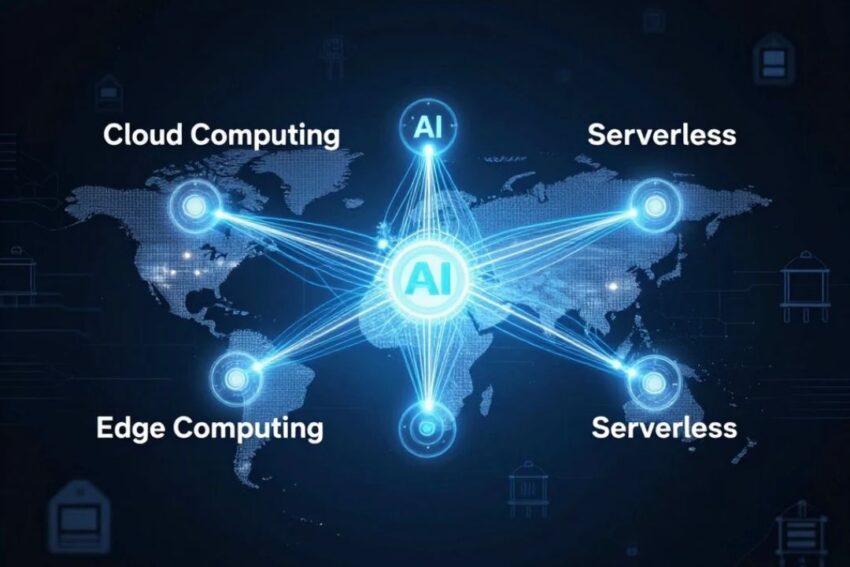
Introduction
Cloud computing is evolving rapidly in 2026. What was once primarily used for online storage and virtual servers has become a critical foundation for artificial intelligence, automation, data analytics, cybersecurity, software development, and digital transformation.
Businesses are moving toward cloud-native architectures while developers are adopting serverless technologies, containers, and managed services. At the same time, the growth of AI is creating demand for powerful cloud infrastructure capable of supporting advanced models and data-intensive workloads.
Other important developments include edge computing, hybrid cloud, multi-cloud, confidential computing, sustainable data centers, and AI-powered cloud management.
This article explores the most important cloud computing trends in 2026, their benefits, applications, challenges, and future opportunities.
1. AI-Powered Cloud Computing
Artificial intelligence is one of the biggest forces shaping cloud computing in 2026.
Modern AI applications require significant computing power, storage, networking, and specialized processors. Cloud platforms provide businesses with access to these resources without requiring them to build their own large-scale AI infrastructure.
AI Cloud Applications
Cloud-based AI can support:
- Generative AI
- AI assistants
- Machine learning
- Predictive analytics
- Computer vision
- Natural language processing
- Recommendation systems
- Business automation
AI is also being used to improve cloud operations themselves.
For example, AI-powered tools can help identify unusual behavior, predict infrastructure demand, and optimize resource usage.
2. Generative AI and Cloud Infrastructure
Generative AI has created a new category of cloud workloads.
Large AI models require substantial computing resources for:
- Training
- Fine-tuning
- Inference
- Data processing
Cloud providers are therefore investing heavily in specialized AI infrastructure, including GPUs and other accelerators.
Why This Matters
Businesses can access advanced AI infrastructure without purchasing and maintaining their own large hardware clusters.
This makes experimentation with AI more accessible to startups and smaller organizations.
3. Edge Computing
Edge computing is becoming increasingly important as connected devices generate more data.
Traditional cloud architecture often sends information to centralized data centers.
Edge computing moves some processing closer to the source of the data.
Benefits
This can reduce:
- Latency
- Network traffic
- Response times
Real-World Applications
Edge computing can support:
- Autonomous vehicles
- Smart factories
- IoT devices
- Healthcare systems
- Smart cities
- Gaming
- Industrial automation
Cloud and edge computing are increasingly being used together.
4. Serverless Computing
Serverless computing allows developers to run application code without directly managing traditional servers.
The cloud provider handles much of the underlying infrastructure.
Advantages
Serverless architecture can provide:
- Automatic scaling
- Reduced infrastructure management
- Faster development
- Event-driven execution
- Usage-based pricing
Developers can focus more on application logic and less on server administration.
Common Applications
Serverless technologies can power:
- APIs
- Web applications
- Background jobs
- Data processing
- Automation workflows
5. Cloud-Native Applications
Cloud-native development is becoming a standard approach for modern software.
Cloud-native applications are designed specifically to take advantage of cloud infrastructure.
They commonly use:
- Containers
- Microservices
- APIs
- Kubernetes
- Serverless functions
- Automated deployment
Benefits
Cloud-native architecture can improve:
- Scalability
- Deployment speed
- Reliability
- Development flexibility
It also makes it easier for organizations to update individual application components without rebuilding the entire system.
6. Kubernetes and Containerization
Containers have become a major part of cloud-native development.
Containers package an application together with its dependencies, allowing it to run consistently across environments.
Kubernetes helps organizations manage large numbers of containers.
Kubernetes Can Automate
- Deployment
- Scaling
- Service discovery
- Load balancing
- Container recovery
Managed Kubernetes services from major cloud providers make container orchestration more accessible.
7. Hybrid Cloud Growth
Hybrid cloud combines private infrastructure with public cloud resources.
This approach remains important for organizations that need a balance between control and flexibility.
Why Businesses Use Hybrid Cloud
Organizations may keep certain workloads private because of:
- Security
- Compliance
- Performance
- Legacy systems
At the same time, they can use public cloud infrastructure for:
- Scalability
- AI
- Analytics
- Development
Hybrid cloud allows businesses to choose the most appropriate environment for each workload.
8. Multi-Cloud Strategies
Some organizations are adopting multiple cloud providers.
A company might use one provider for AI, another for analytics, and another for specific infrastructure services.
Potential Benefits
Multi-cloud can provide:
- Greater flexibility
- Access to specialized services
- Reduced dependency on one provider
- Geographic options
Challenges
Multi-cloud also creates additional complexity.
Organizations must manage:
- Multiple security environments
- Different pricing systems
- Different APIs
- Multiple skill sets
Effective management is essential.
9. Cloud Cybersecurity
As more organizations move sensitive workloads to the cloud, cybersecurity remains a major priority.
Cloud security technologies are increasingly focused on:
- Identity management
- Encryption
- Zero-trust security
- Threat detection
- Automated monitoring
- Security analytics
Zero Trust
Zero-trust architecture assumes that users and devices should not automatically be trusted.
Access is continuously evaluated based on factors such as identity, permissions, device status, and context.
10. Confidential Computing
Confidential computing is designed to protect sensitive data while it is being processed.
Traditional security often focuses heavily on protecting data when it is stored or transmitted.
Confidential computing adds protection during processing through specialized hardware and trusted execution technologies.
Potential Applications
This can be useful for:
- Banking
- Healthcare
- Government
- Enterprise AI
- Sensitive research
As organizations move more sensitive workloads to cloud platforms, confidential computing may become increasingly important.
11. AI-Powered Cloud Management
Cloud environments can become complicated as organizations deploy thousands of applications and resources.
AI can help automate cloud operations.
AI Can Help With
- Resource optimization
- Performance monitoring
- Cost analysis
- Anomaly detection
- Capacity planning
- Security alerts
This approach is sometimes associated with intelligent cloud operations.
The goal is to reduce manual work while improving infrastructure performance.
12. Cloud Cost Optimization
Cloud spending remains an important issue for businesses.
Organizations may accidentally spend money on:
- Unused virtual machines
- Oversized resources
- Excessive storage
- Unnecessary data transfers
Cost Optimization Strategies
Businesses can:
- Monitor cloud usage.
- Remove unused resources.
- Automatically scale infrastructure.
- Choose appropriate resource sizes.
- Optimize storage.
- Review cloud bills regularly.
AI-powered tools can also help identify unnecessary spending.
13. Sustainable Cloud Computing
Data centers require significant amounts of electricity and cooling.
As cloud usage grows, sustainability is becoming an important consideration.
Cloud providers are investing in:
- Renewable energy
- Efficient cooling
- Energy-efficient hardware
- Better data-center designs
- Workload optimization
Why Sustainable Cloud Matters
More efficient infrastructure can potentially reduce energy consumption while supporting growing digital workloads.
Sustainability is becoming increasingly important for both businesses and cloud providers.
14. Cloud Databases
Cloud databases continue to grow as organizations move data-intensive applications online.
Modern cloud databases can provide:
- Automatic scaling
- Managed backups
- High availability
- Global distribution
- Analytics capabilities
Organizations can choose between relational databases, NoSQL systems, data warehouses, and specialized database technologies depending on their workloads.
15. Cloud Data Analytics
Businesses generate enormous amounts of data.
Cloud platforms provide scalable infrastructure for analyzing this information.
Cloud analytics can support:
- Customer insights
- Sales forecasting
- Fraud detection
- Operational optimization
- Business intelligence
- AI training
The combination of cloud computing, big data, and AI is creating powerful new opportunities.
16. Cloud Automation
Automation is becoming essential for managing complex cloud infrastructure.
Organizations use automation to handle:
- Infrastructure deployment
- Application updates
- Backups
- Scaling
- Security checks
- Monitoring
Infrastructure as Code allows cloud environments to be created and managed using configuration files and automated processes.
This improves consistency and reduces manual errors.
17. Infrastructure as Code
Infrastructure as Code, or IaC, allows infrastructure configurations to be defined through code.
Instead of manually creating resources, developers and infrastructure teams can automate deployments.
Benefits
IaC can provide:
- Repeatability
- Version control
- Faster deployment
- Consistency
- Easier disaster recovery
It has become a key technology for DevOps and cloud-native development.
18. Cloud Observability
Modern applications may consist of hundreds of distributed services.
Traditional monitoring alone may not provide enough information to understand complex systems.
Cloud observability uses:
- Metrics
- Logs
- Traces
- Events
to provide deeper insight into application behavior.
Benefits
Observability can help teams:
- Find performance problems
- Diagnose failures
- Monitor applications
- Improve reliability
19. Industry-Specific Cloud Platforms
Another emerging trend is the development of specialized cloud environments for specific industries.
Examples include cloud solutions designed for:
- Healthcare
- Banking
- Government
- Manufacturing
- Retail
- Education
Industry-specific platforms can include specialized compliance, security, analytics, and workflow capabilities.
20. Cloud Gaming
Cloud computing is also changing gaming.
Cloud gaming allows games to run on remote infrastructure while players receive streamed gameplay on supported devices.
Potential Benefits
Players may not need extremely powerful local hardware for every game.
Cloud gaming can support:
- PCs
- Smartphones
- Tablets
- Smart TVs
- Gaming consoles
The major challenge is network quality and latency.
Cloud Computing and 5G
5G networks can complement cloud and edge computing.
Higher network performance can enable faster communication between devices and cloud infrastructure.
Potential applications include:
- Smart cities
- Connected vehicles
- Industrial IoT
- Remote operations
- Augmented reality
- Real-time analytics
The combination of 5G, edge computing, and cloud infrastructure could support new types of connected applications.
Cloud Computing Challenges in 2026
Despite rapid innovation, organizations face several challenges.
Security
Cloud environments require strong identity and access controls.
Cost
Poor resource management can create unexpectedly high bills.
Complexity
Modern cloud environments can involve thousands of services and resources.
Vendor Lock-In
Organizations may find it difficult to move applications between providers.
Compliance
Businesses must ensure that cloud deployments meet relevant regulations.
Skills Shortage
Organizations need professionals who understand cloud infrastructure, security, automation, data, and AI.
Cloud Computing Career Opportunities
Cloud growth is creating demand for skilled professionals.
Popular roles include:
- Cloud engineer
- Cloud architect
- DevOps engineer
- Cloud security engineer
- Site reliability engineer
- Data engineer
- AI infrastructure engineer
Skills to Learn
A strong cloud career can involve learning:
- Networking
- Linux
- Cloud platforms
- Containers
- Kubernetes
- Python
- Infrastructure as Code
- Cybersecurity
- Automation
- AI infrastructure
Future of Cloud Computing
The future of cloud computing is likely to be increasingly intelligent, distributed, automated, and specialized.
AI could help cloud systems automatically:
- Predict workloads
- Optimize resources
- Detect security threats
- Reduce costs
- Identify infrastructure failures
Meanwhile, edge computing could move more processing closer to users and devices.
Cloud platforms may also become increasingly important for emerging technologies such as:
- Robotics
- Digital twins
- Autonomous systems
- Quantum computing
- Advanced AI
- Internet of Things
Frequently Asked Questions
What is the biggest cloud computing trend in 2026?
AI-powered cloud computing is one of the most significant trends, alongside edge computing, serverless architecture, automation, and cloud-native development.
Why is AI important for cloud computing?
AI applications require significant computing resources, and cloud platforms provide scalable access to processors, storage, networking, and AI services.
What is edge computing?
Edge computing processes data closer to where it is generated, helping reduce latency and network traffic for certain applications.
Is serverless computing the future?
Serverless is likely to remain an important architecture for applications where automatic scaling and reduced infrastructure management are valuable.
Is cloud computing secure?
Cloud platforms provide extensive security capabilities, but organizations must properly configure and manage their applications, identities, permissions, and data.
What skills are needed for cloud computing?
Important skills include cloud platforms, networking, Linux, containers, Kubernetes, automation, cybersecurity, and infrastructure as code.
Conclusion
The top cloud computing trends of 2026 demonstrate how quickly the industry is evolving. Cloud computing is no longer simply about storing files or renting virtual servers. It has become a foundation for AI, automation, data analytics, modern software, cybersecurity, and connected technologies.
Artificial intelligence is driving demand for powerful cloud infrastructure, while edge computing is bringing processing closer to users and devices. Serverless computing and containers are helping developers build applications more efficiently, while Kubernetes and cloud-native technologies are making large-scale deployments easier to manage.
At the same time, businesses are focusing more heavily on cloud security, cost optimization, sustainability, observability, and hybrid or multi-cloud strategies.
Looking ahead, cloud computing is likely to become even more automated and intelligent. The combination of cloud platforms with AI, edge computing, 5G, robotics, and other emerging technologies could create significant opportunities for businesses and technology professionals.
For organizations planning their digital strategies in 2026, understanding these cloud trends is no longer optional. Cloud computing has become a core technology for innovation, scalability, and long-term digital growth.